One drain slow is a clog in that fixture. Every drain slow is the main line. Knowing which one you have before anyone starts work is most of the job.
Drain cleaning in Wake Forest, NC is the work of getting a slow or blocked line moving again and finding out why it closed. Almost all of it is one of two jobs: clearing a local clog in one fixture’s own branch, or clearing a main line clog that has every drain in the house backing up. Those are different visits with different tools, and separating them is the single most useful thing anyone can tell you about a clogged drain.
The houses here split the same way. Older homes toward Youngsville and Franklinton sit on crawl spaces with long, cool drain runs under the floor, which is exactly where warm kitchen grease stops being liquid. Newer Wake Forest subdivisions are on slab with PEX or CPVC, so the supply side is modern but the waste line still has to leave the building and reach the street, and that is where roots and settling do their work. A lot of the Triangle’s construction-era plumbing is now five to twenty years old, which is about when the first real blockage shows up.
People call this different things. Drain snaking, rooter service, unclogging a drain, or just “the sink is backing up.” It is the same trade. What changes the price and the plan is not the name, it is whether the blockage is a foot past the trap or forty feet out under the yard.
Before you call anyone, walk the house and run water in each fixture. What you find here decides whether this is a twenty minute job at one trap or a main line problem, and it is worth saying which on the phone.
A local clog in that fixture’s own branch, usually within a few feet of the drain. A bathroom sink full of hair and soap, a shower that drains slower every month, a kitchen sink that has finally closed. This is the cheap version and a cable normally ends it the same visit.
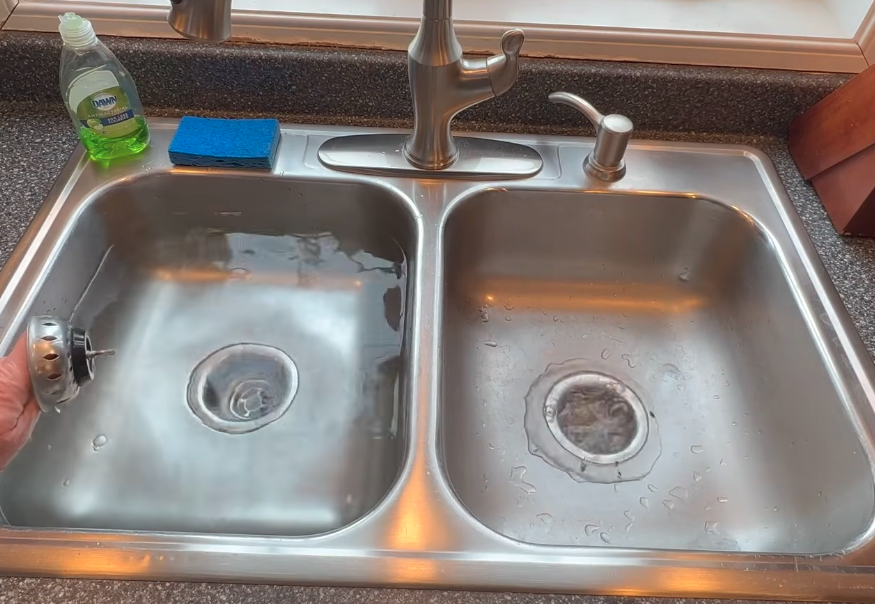
Water standing on one bowl and draining from the other points at the wye under the sink or the disposal itself rather than the branch line. If the unit hums, jams or leaks alongside the backup, it is a garbage disposal problem wearing a drain problem’s clothes.
A tub and a lavatory that slow together usually share a branch, and the clog is at or below the point where they meet. Still not the main line, but further in than a plunger will reach.
Kitchen, baths and laundry all sluggish in the same week is a main line clog until proven otherwise. The house is draining into one pipe and that pipe is closing. Nothing you pour into a single sink reaches it.
Run an upstairs sink and watch the downstairs tub or the floor drain. If water arrives there, the blockage is past that point and the whole house is now feeding it. That is the classic main line signature and it tends to get worse quickly.
A single blocked toilet is usually the toilet, and toilet repair or an auger settles it. A toilet that bubbles when the washing machine drains is not the toilet at all. It is the main line telling you it cannot take the volume.
Cleared in spring, closed again by fall, cleared again. At that point you are renting a solution rather than buying one, and the honest next step is a camera. What it usually finds sits outside the house and needs sewer line repair rather than another cleaning.
Blockages here are not random. Six causes account for nearly every drain we clear, and the local housing stock decides which one you get.
Fat leaves the sink warm and liquid, then hits a drain run crossing an unheated crawl space and sets on the pipe wall. That is why so many older homes toward Youngsville and Franklinton lose the kitchen line first, and why it happens a few yards downstream of the sink rather than at the trap.
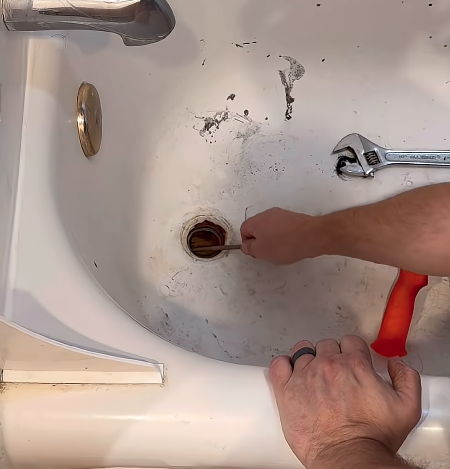
Hair catches on the stopper linkage and the crossbars, soap scum binds it, and the opening shrinks a little every week. It is the slowest clog to arrive and the easiest to clear, which is why a shower that has been getting worse for a year is good news rather than bad.
Whatever the box says, they do not break down the way paper does. They knit together with fat into a mass that a cable tears a hole through and leaves behind. Blockages of exactly this kind are the largest single cause of sanitary sewer overflows, which is why the EPA tracks them at the municipal level.
Mature hardwoods and pines sit over a lot of the older laterals running toward Youngsville and Franklinton. Roots do not break into a sound pipe; they find a joint that has already opened, then catch everything passing by. Clearing them restores flow without closing the gap they came through.
Hard water is the regional constant, on well and town supply alike, and the mineral content that causes it leaves scale everywhere it goes. In galvanized lines it narrows the bore from the inside until the pipe is half the diameter it started as. Cleaning buys time; a line that far gone is a repiping conversation.
Triangle red clay, yard runoff into an open cleanout, and the sand and setting compound left behind in a newer build all settle in the low spots of a line. They build a shoal that slows everything above it. Flushing moves that. Boring a hole through it does not.
Three tools, three jobs. Getting this wrong costs money in one direction or repeat visits in the other, so it is worth being plain about which does what.
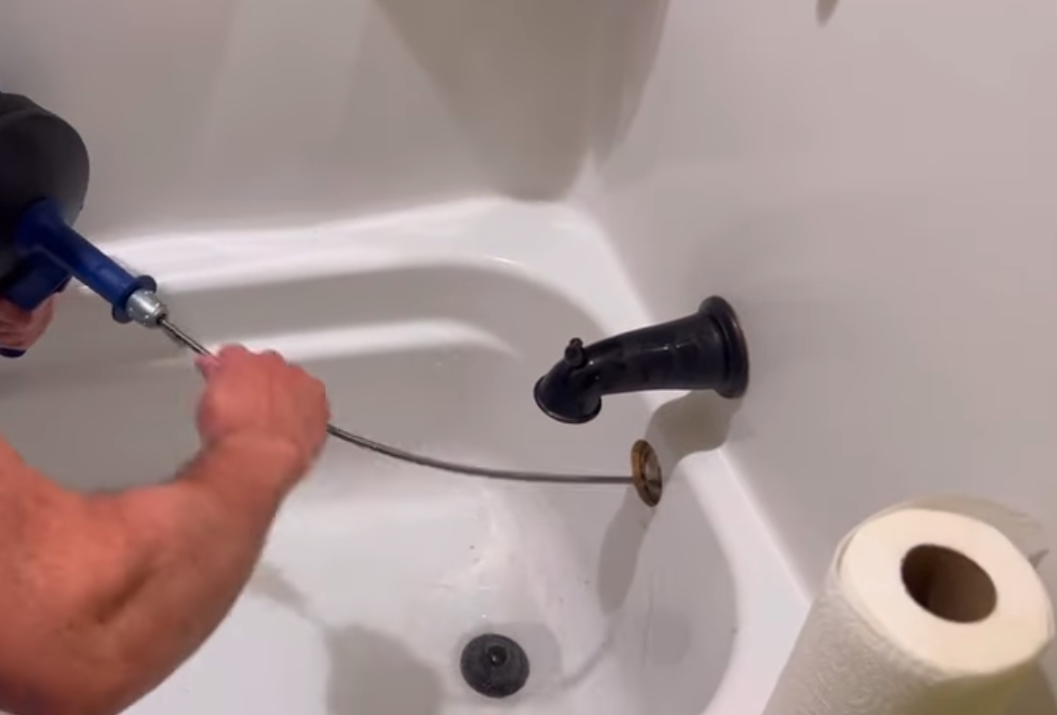
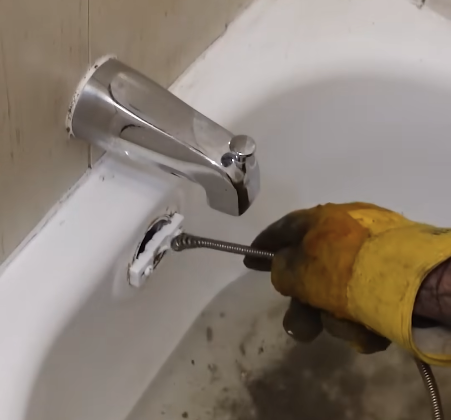
A rotating steel cable is fed down the line until it reaches the blockage and bores through it. Drain snaking is quick, it is the cheapest thing that works, and on a one time clogged sink drain or a hair-blocked tub it is the whole job. Reach for it first and see whether the problem returns.
A cable makes a hole through the blockage; the grease, scale and paper coating the pipe wall stays where it is, and that is where the next clog starts. High pressure water scours the wall instead. When a line has been cleared twice already, hydro jetting is what actually changes the outcome.
The camera shows the pipe material, its condition and what is genuinely blocking it. That is what separates a line full of build-up, which cleans, from a broken or settled one, which does not. It is also the only honest way to recommend the expensive option.
A clog that returns to the same spot is a structural finding, not a maintenance one. Three visits to the same forty-foot mark is the pipe telling you something about itself: a joint that has opened, a section that has settled and holds water, or a crack. Cleaning it again buys months. A camera pass turns the guess into a decision, and often turns the job into sewer line repair instead.
Roughly how the work runs, so nothing on the day is a surprise.
Every fixture gets run. That is not padding the visit; it is the difference between pulling one trap and opening a cleanout, and it is decided in the first few minutes rather than after an hour of work in the wrong place.
A trap, a cleanout, a pulled toilet or a roof vent, depending on where the blockage sits. On older crawl space homes around Youngsville the access is under the floor; on a Wake Forest slab it is usually outside. If you know where your cleanout is, say so when you call.
Cable for a local clog, and the cable size matched to the pipe rather than whatever is already on the truck. For a main line or a line thick with grease, the jetter. You get told which is going in and why before it does.
Fixtures get run at real volume, because a line that takes a trickle is not a line that is clear. If this is a repeat blockage, that is the moment to put a camera down it and find out what keeps causing it.
If sewage is coming up right now, stop using water. Every flush, every wash cycle and every sink adds to what has nowhere to go. Sewage backing into a tub or a floor drain is the one version of this that should not wait for a booked slot: call the 24/7 emergency line on (919) 316-0025. A single slow sink is not that, and booking it is the cheaper route.
It is the first thing most people try and it is usually a poor trade. Those products work by caustic reaction and the heat that comes with it. In a modern PVC waste line that is survivable. In the older galvanized and cast iron still under a lot of homes in this county, and against the rubber and plastic parts inside a trap and a disposal, repeated doses do real damage.
The bigger problem is what they leave. At best the product melts a channel through the blockage, which restores flow and leaves the grease or hair ring exactly where it was. The line closes again, usually sooner, and the second dose has less effect than the first. And if it does not clear, the pipe now holds standing caustic liquid that whoever opens the trap has to deal with.
What actually works is unglamorous. Keep fat, oil and grease out of the sink, including what rinses off a hot pan and out of a mixing bowl. Run cold water while a disposal is grinding so fat stays solid and keeps travelling instead of coating the pipe. Put a basket strainer in the kitchen sink and a hair catcher in the shower. Flush nothing but paper. If a fixture is genuinely slowing month over month, clear it while it is still a cable job rather than waiting for it to close on a Sunday.
Most clogs are a cable and half an hour. Selling a jetter to someone who needs a snake is how a plumber loses a street, and word travels fast in a county this size.
Where a camera goes down, you see the footage. You also get told which parts of what we found are certain and which are a judgement call.
A shop on Park Avenue in Youngsville that works Wake Forest, Rolesville, Franklinton and Louisburg, roughly fifteen minutes down US 1 rather than an hour out from a call queue.
Sewage ejector pumps, grinder pumps and sump pumps sit on a circuit as well as a pipe. We are licensed for both, so a pump that will not run does not need two contractors.
A restaurant kitchen line closing on a cycle is a scheduling problem as much as a plumbing one. Our commercial plumbing page covers how that gets worked around opening hours.
We run discounts for veterans and active duty military, first responders, teachers and seniors. Current amounts are on the specials page.
From the shop in Youngsville out across the Triangle — Wake Forest, Rolesville, Franklinton and north Raleigh
White’s Plumbing & Electrical, LLC
730 Park Ave, Youngsville, NC 27596
Service and estimates: (919) 435-0736
24/7 emergency: (919) 316-0025
Drain cleaning in Youngsville, NC is a few minutes from the shop, and Wake Forest is roughly a fifteen minute run down US 1 from it. We also cover Rolesville, Franklinton, Louisburg, Bunn, Zebulon, Wendell, Knightdale, north Raleigh, Durham, Henderson and Clayton. One thing worth knowing when you call: Wake Forest is on town water while much of Franklin County runs on private wells, and a house on a well has a pump and pressure tank in the story as well as a drain. The rest of what we do is on the plumbing services page.
Check the other drains. If one sink is slow and everything else in the house runs normally, the clog is in that fixture's own branch. If several fixtures slow down together, or the lowest drain in the house backs up when you run water upstairs, the main line is the problem. That second case is a different job, and it is worth saying which one you are seeing when you call.
It is usually a poor trade. Those products work by caustic reaction and heat, which is hard on older galvanized and cast iron pipe and on the rubber and plastic parts inside a trap. That is exactly what a lot of older homes toward Youngsville and Franklinton still have under the floor. At best the product opens a channel through the blockage and leaves the cause sitting there, and the next person to open that pipe is working in standing caustic liquid.
Both, and a cable is the right call more often than a jetter. Drain snaking clears most single fixture clogs quickly, and on a one time clogged sink drain that is the whole job. Jetting is for lines coated in grease or scale, or lines that close again every few months. Paying for the bigger tool on a simple clog is money spent for nothing.
A clog that returns to the same place is usually telling you something structural. Roots at a joint, a section that has settled and holds water, a crack, or a length of pipe narrowed by years of scale. A camera inspection is the only way to see which one it is, and it often changes the answer from cleaning the line again to repairing it.
Yes. The shop is on Park Avenue in Youngsville, about fifteen minutes from Wake Forest, and we cover Youngsville, Rolesville, Franklinton, Louisburg, Bunn, Zebulon, Wendell, Knightdale and north Raleigh. Homes on the Franklin County side are more often on crawl spaces, which changes where a line gets reached and how long the access takes.
Roots can be cut back and washed out, and the line will run again afterward. What that does not do is close the crack or open joint the roots came in through, so they grow back. In Franklin County that finding usually comes from an older clay or cast iron lateral, and it points toward a repair rather than a cleaning every spring.
The emergency line runs around the clock on (919) 316-0025. Use it when sewage is coming up into a tub or a floor drain, or when nothing in the building will drain at all. A single slow sink can wait for a booked slot, and booking it is the cheaper way to handle it.
Keep fat, oil and grease out of the sink, including what rinses off a hot pan. Run cold water while a disposal is grinding so fat stays solid and keeps moving instead of coating the pipe. Use a basket strainer in the kitchen and a hair catcher in the shower. None of that rescues a line that is already coated, but it is most of what keeps a clean line clean.
Tell us which fixtures are slow and whether it has happened before. That is usually enough to know what the visit needs before anyone turns up.
White’s Plumbing & Electrical, LLC · 730 Park Ave, Youngsville, NC 27596 · 24/7 emergency (919) 316-0025